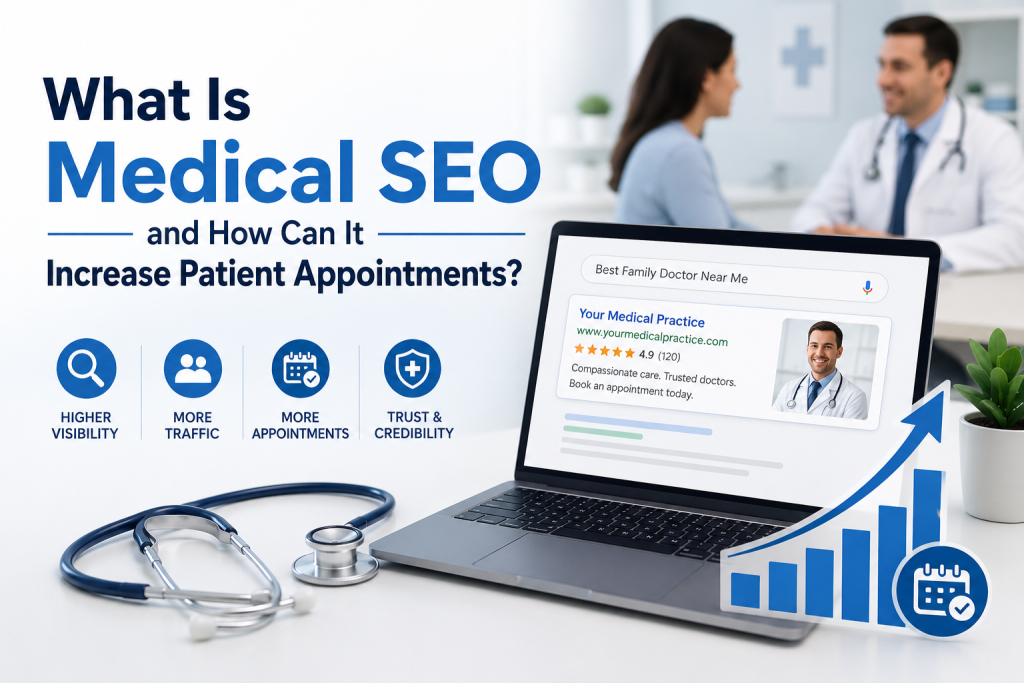
How do patients find a doctor, clinic, or hospital in 2026? They search Google, scan a map, read reviews, compare a few options, and book an appointment with whoever looks credible. Medical SEO is what makes sure your practice is one of those options. In simple terms, medical SEO is the process of optimizing a healthcare website so it appears higher in search results when patients look for doctors, clinics, or healthcare services online. A well-executed strategy increases patient appointments by improving visibility, trust, and local search presence. This guide explains what medical SEO is, how it differs from traditional SEO, how patients search, the ranking factors that move the needle, and what a 2026 practice should do to grow through search.
What Is Medical SEO and Why Is It Different From Traditional SEO?
Medical SEO is search engine optimization tailored for healthcare providers, including doctors, clinics, hospitals, dental practices, specialty centers, and allied health services. It covers the full set of signals that affect how visible a healthcare website is when a patient searches for treatment, a condition, or a provider.
What makes medical SEO different is the trust threshold. Healthcare is a YMYL (Your Money or Your Life) topic in Google’s quality framework, so search engines apply higher standards to medical content. A page that confidently recommends the wrong treatment will be discounted or excluded. SEO for doctors, SEO for clinics, and SEO for hospitals all have to balance visibility with credibility, accuracy, and patient trust in a way that other industries do not. Content has to be accurate and authoritative, provider credentials visible, local signals tight, and the experience has to make it easy for a patient to convert.
Why Is SEO Important for Doctors, Clinics, and Healthcare Providers?
Most patients begin their healthcare journey online. Roughly 77% of patients use search engines before booking a healthcare appointment, and a provider’s online presence is a major factor in their choice. SEO is the long-term patient acquisition system that compounds month after month, and it is one reason practices that pair a strong digital marketing strategy with disciplined SEO execution outpace competitors that rely on referrals alone.
How Do Patients Search for Healthcare Services Online?
Modern healthcare search behavior is more varied than most practices assume. Patients search by symptom, by condition, by treatment, by doctor, by clinic, by location, and increasingly by voice. They search on mobile, on desktop, in Maps, and through AI assistants. Understanding the shape of those searches is the first step to showing up in them.
What Types of Healthcare Searches Do Patients Perform Before Booking an Appointment?
Common searches: “best dentist near me,” “orthopedic specialist in [city],” “treatment for lower back pain,” “pediatric clinic open today.” These fall into three intent categories that practices should plan for separately.
- Informational searches. The patient is researching a condition, symptom, or treatment. Examples include “what causes lower back pain” or “Invisalign vs braces.”
- Navigational searches. The patient is looking for a specific provider, clinic, or hospital. Examples include “[clinic name] hours” or “Dr [name] reviews.”
- Transactional searches. The patient is ready to book. Examples include “book dermatologist appointment near me” or “orthopedic specialist accepting new patients.”
Each intent category needs its own content and conversion path. Informational content builds trust and authority. Navigational content confirms credibility. Transactional content converts.
How Important Is Local Search for Medical Practices?
Local search is critical. Most patients book within a short drive, and the Google Map Pack above the organic results is the single most-clicked element for healthcare searches. Local signals include Google Business Profile completeness, map pack rankings, reviews, and location-based searches. Local seo for doctors is the highest-leverage area for any practice whose patients come from a defined service area.
How Does Mobile Search Influence Patient Decisions?
Mobile healthcare searches continue to grow. More than half of smartphone users have discovered a new business while searching on their phone, which maps directly onto how patients find new providers. Mobile behavior drives click-to-call actions, mobile appointment booking, and direct navigation to a clinic. Page speed, mobile usability, and clear contact information all directly affect whether a mobile search becomes a booked appointment, which is why healthcare website optimization has to be mobile-first.
How Can Medical SEO Help Increase Patient Appointments?
Medical SEO supports patient appointment growth in four concrete ways, each tied to a stage of the patient journey.
Visibility, Trust, and Conversion Through Healthcare Marketing SEO
Healthcare marketing SEO puts your practice in front of patients who are actively looking for care. Visibility is the top of the acquisition funnel, and patients who find you at the moment of intent are far more likely to convert than patients reached through general brand awareness.
Search-to-Appointment: How Healthcare Website Optimization Converts
Healthcare website optimization turns a search visit into a booked appointment. Optimized pages encourage appointment requests, click-to-call actions, and online booking. Trust signals like author credentials, real patient reviews, and clear service information reduce the friction between “I might book” and “I will book.” Local discovery, driven by Google Business Profile and map pack visibility, ensures that patients searching nearby actually find the practice.
A realistic patient journey: search for a treatment, scan of organic results and the map pack, click through, review of credentials and reviews, and finally a phone call, form submission, or online booking. Healthcare marketing SEO is designed around this journey, which is why medical seo services consistently outperform generic marketing for healthcare patient acquisition.
What Are the Most Important Ranking Factors for Medical Websites?
Google uses hundreds of signals to rank medical websites, but a handful carry most of the weight. Healthcare websites face higher quality standards than most industries, and each of these factors has to be tight.
- Content quality. Accurate medical information, written or reviewed by qualified professionals, that addresses what patients actually want to know.
- E-E-A-T signals. Author credentials, medical expertise, trustworthiness, and verifiable experience. The full quality framework is documented in Google’s Helpful Content guidelines, and the higher bar for YMYL topics is spelled out in Google’s search quality guidelines.
- Technical SEO. Site speed, mobile friendliness, secure HTTPS, and a clean site architecture. None of the rest of the strategy works if the technical foundation is broken.
- Local SEO signals. Reviews, citations, and a complete Google Business Profile. These drive map pack rankings and local discovery.
- User experience. Easy navigation, accessible contact information, fast booking paths, and content that respects the patient’s time and stress level.
Medical website seo has to cover all of these in coordination. A site that is technically fast but has thin E-E-A-T, or strong E-E-A-T but a slow site, will underperform both.
How Can Healthcare Providers Improve Their Local SEO Presence?
Local SEO is where most healthcare appointment growth is won or lost. Most patients book within a short drive, and showing up in the local map pack and the local organic results is what actually fills the schedule.
Why Local SEO for Doctors Is the Highest-Leverage Channel
Local seo for doctors is the highest-leverage channel, and the work has five parts, each compounding the others.
- Optimize Google Business Profile. A complete profile, accurate categories, services listed individually, current hours, photos uploaded regularly, and weekly posts to signal activity.
- Build local citations. List the practice consistently in healthcare directories, general directories, and local business registries. Name, address, and phone number must match exactly across every listing.
- Encourage patient reviews. Review velocity is a direct local ranking factor, and review quality drives conversion. Make it easy for patients to leave a review after their visit.
- Create location pages. Multi-location practices need a unique page for each location. Single-location practices can use neighborhood or district pages to capture surrounding searches.
- Create local healthcare content. Local health guides, community health content, and condition pages that mention the service area build topical and geographic authority.
Local seo for doctors is the discipline of running all five in coordination, and it is also where healthcare seo investments produce the fastest measurable returns.
What Type of Content Performs Best for Medical SEO?
Content is the engine of medical SEO. The right mix of page types turns a healthcare website into a patient acquisition system that runs even when the office is closed, and medical website seo lives or dies on the quality of that content.
Service Pages, Condition Pages, and Healthcare Website Optimization
Service pages target each treatment or service a practice offers. Condition pages target specific conditions a patient might be searching for. Both match high-intent searches and convert visitors into appointment requests when written and structured well. Healthcare website optimization starts with these high-value pages and supports them with deeper educational content.
FAQ pages directly match how patients search and are highly likely to surface in featured snippets and AI Overviews. Patient education content builds the topical authority that supports the conversion pages. Local healthcare guides tie the practice to the community it serves and support local SEO. Together, this content mix helps patients at every stage of their journey, from the first symptom search to the booked appointment.
What Are the Most Common Medical SEO Mistakes to Avoid?
Most underperforming medical websites fall into the same handful of traps.
- Thin content. Pages with no real information. Search engines cannot rank what they cannot evaluate, and patients cannot book what they do not understand.
- Keyword stuffing. Forcing medical keywords into copy until it reads unnaturally. Google ignores or penalizes this.
- Ignoring local SEO. Treating a clinic’s website as if patients search nationally. Almost all healthcare searches are local.
- Poor mobile experience. Slow load times, broken layouts, and click-to-call buttons that are hard to tap. Most healthcare searches happen on phones.
- Lack of trust signals. No author credentials, no schema, no clear contact information, and no review strategy.
- Missing author credentials. Anonymous content on healthcare topics. The E-E-A-T bar is higher for YMYL, and unattributed content will not clear it.
- Outdated medical information. Pages that recommend outdated treatments, list old hours, or cite retired providers. Trust collapses quickly.
Each mistake reduces both rankings and patient trust, and most of them are fixable in a focused quarter of work.
What Should a Successful Medical SEO Strategy Include in 2026?
A modern medical SEO strategy rests on five pillars, with two more that have become essential in 2026.
- Technical SEO. Site speed, mobile optimization, crawlability, secure HTTPS, and a clean site architecture.
- Local SEO. Maps visibility, local citations, reviews, and location pages. The highest-leverage pillar for any healthcare practice.
- Content strategy. Service pages, condition pages, FAQs, and patient education content built around actual patient search behavior.
- E-E-A-T optimization. Credentials, expert authorship, trust signals, and a verifiable team. Healthcare YMYL standards apply.
- AEO (Answer Engine Optimization). Direct answers, featured snippets, FAQ optimization, and structured content that AI systems can lift cleanly.
- GEO (Generative Engine Optimization). AI Overviews, ChatGPT visibility, entity authority, and AI-generated answers. A useful reference is Google’s AI Overviews documentation.
AI-powered search is changing healthcare discovery. Google now often answers the question directly rather than sending traffic to ten blue links. Practices that show up in those AI answers will get the patient, even if they never visit a website. Medical seo services in 2026 are increasingly judged on AI-overview visibility, not just blue-link rankings. Healthcare websites that prepare for AI-driven search with structured content and verifiable expertise will be the ones that win patient attention in 2026 and beyond.
To see what an integrated approach looks like, it helps to talk to a team that treats SEO as a growth system, or to look at the team behind the strategy.
Frequently Asked Questions
How Long Does Medical SEO Take to Show Results?
Most healthcare practices see meaningful movement in three to six months, with the strongest gains typically appearing between months six and twelve. Local SEO signals like GBP and reviews often move faster, while organic rankings for competitive medical terms take longer. The timeline depends on your starting point, market competition, and execution consistency.
How Much Does Medical SEO Cost?
Pricing varies based on goals, competition, location, and scope. A single-physician practice in a less competitive market will pay less than a multi-location hospital group in a dense urban area. The right question is ROI: a well-executed strategy typically pays for itself many times over through new-patient lifetime value.
Can Small Clinics Compete With Large Hospitals Using SEO?
Yes. Local relevance, specialty focus, and patient-experience signals can give small clinics a real edge against large hospitals in their service area. Search engines weight proximity, specialty clarity, and review quality heavily, and small clinics can win on all three with the right strategy instead of competing on the same broad keywords as large systems.