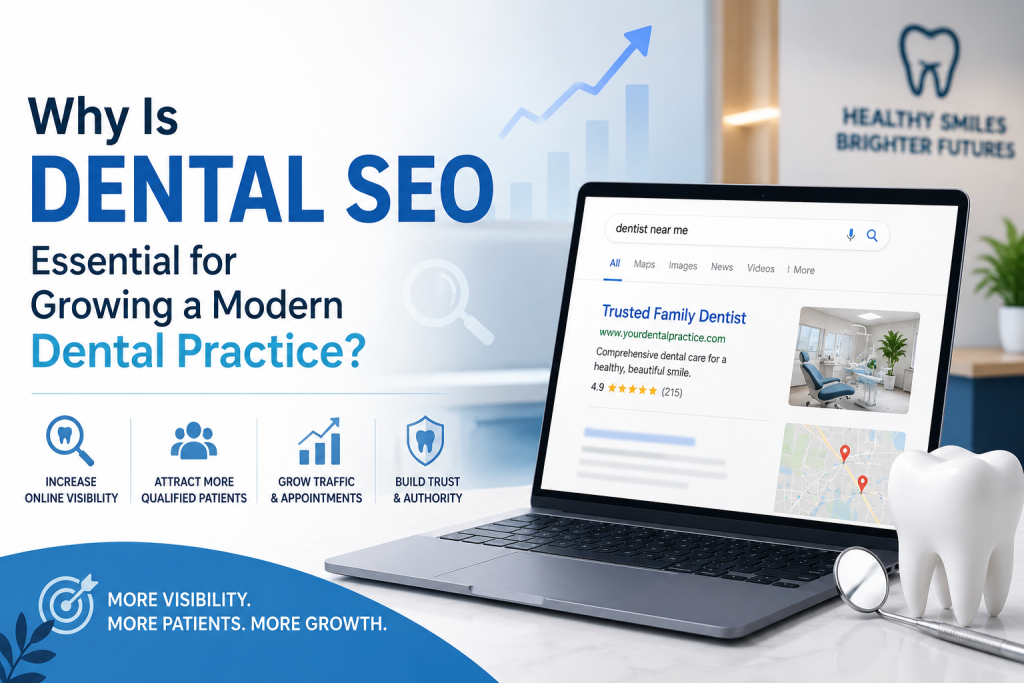
How do patients actually pick a dentist in 2026? They type a search into Google, scan a map, read a few reviews, and book whoever looks credible enough to call. Dental SEO makes sure your practice is one of the options they see in that critical first window. In simple terms, dental SEO is the practice of optimizing your clinic’s website, content, local listings, and reputation so patients searching for dental services find you first. A strong strategy increases qualified website traffic, builds local visibility in Google Maps, and drives more appointment bookings. This guide explains how dental SEO works, why patient behavior makes it non-negotiable, and the steps a 2026 practice should take to grow through search.
What Is Dental SEO and How Does It Work?
Dental SEO is part of medical SEO and it’s search engine optimization tailored for dental practices. It covers everything that affects how visible your clinic is when someone searches for treatments, services, or dentists in your area. It blends the technical side of SEO (site speed, schema, mobile usability) with the human side (content, reviews, local relevance) to match how real patients search.
Search engines connect patients to dentists by reading signals across your website, your Google Business Profile, your reviews, and the wider web. When a patient searches “dentist near me” or “dental implants specialist,” Google weighs hundreds of factors to decide which practices deserve the top spots. Dental searches are almost always local, often urgent, and tied to a high-trust decision, so dental practice SEO has to balance visibility with credibility signals like credentials and real reviews. Dental website SEO covers the on-page and technical work, while local SEO handles the geographic visibility that drives most patient inquiries.
Why Do Most Patients Search Online Before Choosing a Dentist?
Patient behavior has changed. The first thing a new patient does is search, and that single habit now decides who gets the appointment. According to the PatientPop “Patient Perspective” report, roughly 77% of patients used search engines before booking a healthcare appointment, and most said a provider’s online presence was a major factor in their choice.
Modern patients research before they book. They read reviews, compare providers, search for specific treatments, and do most of this on mobile, often in the moments before they decide to call. Google’s research on mobile micro-moments shows that more than half of smartphone users have discovered a new business while searching on their phone, a pattern that maps directly onto how patients find new dentists. This is one reason practices that pair a strong digital marketing strategy with disciplined execution outpace competitors that rely on word-of-mouth alone.
Common dental searches include “dentist near me,” “best cosmetic dentist,” “emergency dentist open now,” and “dental implants specialist.” These are highly commercial, and the patient is past the research stage. If your practice does not appear in those results, the patient simply books with whoever does. A clinic that ranks on page one for its core service searches will see a steady stream of qualified inquiries.
How Can Dental SEO Help Attract More Patients to Your Practice?
Dental SEO supports practice growth in four ways, each tied to a stage of the patient journey.
Increased Visibility and Trust Through SEO for Dentists
SEO for dentists keeps your practice in front of patients who are actively looking for care. High-ranking practices are also perceived as more credible, especially in healthcare.
How Dental Marketing SEO Drives Better Patient Quality
Dental marketing SEO attracts people actively searching for dental services, not casual scrollers. The leads you get are warmer, the calls are more qualified, and the conversion to a booked appointment is higher than with most channels. More visibility, more trust, and better-qualified leads combine into more inquiries and bookings, month after month. Unlike paid ads, the gains compound.
A realistic patient journey: Google search for a treatment, scan of organic results and the local map pack, click through to a few practice websites, read reviews, and pick up the phone. Dentist seo services are designed around this exact journey, which is why they outperform generic marketing for dental patient acquisition.
Which Dental Services Benefit Most From SEO?
Almost every dental specialty benefits from SEO, but the services that combine high patient demand with high commercial value see the strongest returns. Each benefits from a dedicated service page that matches how patients search.
- General dentistry: routine checkups, cleanings, fillings, and family dentistry
- Cosmetic dentistry: veneers, bonding, smile makeovers, and aesthetic procedures
- Dental implants: a high-value, high-intent search category
- Orthodontics: traditional braces and clear aligners for adults and teens
- Invisalign: a high-volume, treatment-specific keyword family
- Pediatric dentistry: a separate search audience with its own trust dynamics
- Emergency dentistry: urgent, time-sensitive searches that convert fast
- Oral surgery: extractions, wisdom teeth, and surgical procedures
Service-specific pages improve both visibility and conversion. A patient searching “Invisalign provider in [city]” wants a page that speaks to that treatment, shows clear pricing, and reassures them about the process. Dental clinic SEO thrives on this specificity.
What Are the Most Important Ranking Factors for Dental Websites?
Google uses hundreds of signals, but a handful carry most of the weight.
- Content quality. Clear, patient-focused content on every service. Thin or duplicate pages drag rankings down.
- Local relevance. NAP consistency and location mentions that tell Google where you practice.
- Google Business Profile. A complete, verified, frequently updated GBP is the single biggest lever for local rankings.
- Website speed. Slow sites lose both rankings and patients. Aim for sub-two-second mobile load times.
- Mobile friendliness. Most dental searches happen on phones. Mobile-first design is no longer optional.
- Reviews and reputation. Quantity, recency, and quality influence both rankings and patient decisions.
- Backlinks and authority. Links from reputable healthcare, local, and industry sources signal authority.
- User experience. Easy navigation, clear calls to action, and fast booking paths.
Each factor influences both rankings and patient trust, which is why dental website SEO has to cover the full picture.
How Can Local SEO Help Dental Practices Dominate Their Service Areas?
Local SEO is the single highest-leverage area for dental practices. Most patients book within a short drive, so showing up in the local map pack and organic results is what actually fills chairs.
Local SEO for Dentists: Google Business Profile
Start with Google Business Profile optimization: a fully completed profile, accurate categories, services listed individually, current hours, photos uploaded regularly, and weekly posts. The profile often appears in the map pack above the organic results, and it is what most patients click first. Build local citations across healthcare directories and local business registries, with your name, address, and phone number matching exactly across every listing; inconsistencies quietly cost rankings. Encourage patient reviews; review velocity is a direct local ranking factor, and review quality drives conversion.
Local SEO for Dental Clinics Across Multiple Locations
Create local landing pages for each location. A multi-location practice should have a unique page for each clinic, with locally relevant content, embedded maps, and location-specific service information. A single-location practice can use neighborhood pages to capture searches from surrounding areas. The strongest local signals are GBP completeness, review velocity, searcher proximity, and category relevance.
What Type of Content Helps Dental Websites Rank Higher?
Content is the fuel that powers dental SEO. The right mix of page types turns a dental website into a patient acquisition engine.
Dental Website SEO and Service Pages
One dedicated page per treatment, optimized for a specific search intent. Examples include dental implants, veneers, teeth whitening, and Invisalign. These pages match the high-intent searches patients run when they are ready to book. FAQ pages directly match how patients search and are highly likely to surface in featured snippets and AI Overviews. Patient education articles build topical authority, and treatment comparison guides (Invisalign vs braces) help patients decide and naturally earn backlinks. Local dental guides tie your practice to the area you serve.
How Does Google’s E-E-A-T Framework Affect Dental SEO?
Google’s E-E-A-T framework stands for Experience, Expertise, Authoritativeness, and Trustworthiness. For dental websites, it is a core ranking requirement, and the standard is higher than in most other industries.
- Experience. Showcase real-world clinical experience. Before-and-after galleries, case studies, and treatment timelines all help.
- Expertise. Demonstrate professional knowledge through credentials, specializations, and continuing education. Author bios with verifiable qualifications are essential.
- Authoritativeness. Build recognition within dentistry through mentions in reputable dental publications, links from healthcare sites, and listings in recognized professional directories.
- Trustworthiness. Maintain accurate information, transparent credentials, secure HTTPS, and visible contact information. Reviews and clear policies all strengthen trust.
Google holds healthcare websites to higher standards because the cost of bad information is real. E-E-A-T directly influences rankings, patient confidence, and how your content appears in AI-generated search results. The full quality framework is documented in Google’s Helpful Content guidelines, and the higher bar for YMYL topics like healthcare is spelled out in Google’s search quality guidelines.
What Are the Most Common Dental SEO Mistakes That Limit Growth?
Most underperforming dental websites fall into the same traps.
- Ignoring local SEO. Almost all dental searches are local.
- Thin service pages. Single-paragraph pages with no detail, no FAQs, and no schema. Search engines cannot rank what they cannot evaluate.
- Duplicate content. Copying descriptions from manufacturer sites or other clinics. Google ignores or penalizes duplicates.
- Poor mobile experience. Slow load times and broken layouts. Most dental searches happen on phones.
- Missing Google Business Profile optimization. An unclaimed, incomplete, or stale GBP is the single biggest missed opportunity in local dental marketing.
- Weak internal linking. Pages that do not link to each other in a logical way.
- Lack of patient reviews. Few reviews, or reviews that stop coming in. Review velocity is a local ranking signal.
- Ignoring E-E-A-T principles. Anonymous content, no author credentials, no schema, and a thin trust profile.
The consequence of each mistake is the same: lower visibility, fewer patient inquiries, and slower practice growth.
What Should a Successful Dental SEO Strategy Include in 2026?
A modern dental SEO strategy rests on five pillars, plus two that have become essential in 2026.
- Technical SEO. Site speed, mobile optimization, crawlability, secure HTTPS, structured data, clean site architecture.
- Local SEO. Maps visibility, local citations, reviews, and location pages. The highest-leverage pillar for any dental practice.
- Content marketing. Service pages, educational content, FAQs, and treatment guides. Quality and originality matter more than volume.
- Reputation management. Reviews, brand trust, online authority, and consistent NAP across the web.
- E-E-A-T optimization. Credentials, expert authorship, trust signals, schema markup, and a verifiable team.
- AEO (Answer Engine Optimization). Direct answers, featured snippets, FAQ optimization, and structured content that AI systems can lift cleanly.
- GEO (Generative Engine Optimization). AI Overviews, ChatGPT visibility, entity authority, and AI-generated answers.
AI-powered search is changing patient discovery. Where Google used to send traffic to ten blue links, it now often answers the question directly. Practices that show up in those AI answers will get the patient, even if the patient never visits a website. Dental seo services and dental seo agency work in 2026 are increasingly judged on AI-overview visibility, not just blue-link rankings. The right dental seo company should be able to talk fluently about AEO, GEO, and entity authority. A useful reference is Google’s AI Overviews documentation.
Dentist marketing strategy in 2026 also has to account for multi-modal search. Patients search by voice, by image, and by talking to AI assistants, so clean schema, structured FAQs, and entity-based content prepare your site for all of them. To see what an integrated approach looks like in practice, it helps to talk to a team that treats SEO as a growth system, or to start with a quick look at the team behind the strategy.
Frequently Asked Questions
How Long Does Dental SEO Take to Produce Results?
Dental SEO is a long-term investment. Most practices see meaningful movement in three to six months, with the strongest gains between months six and twelve. Local SEO signals move faster, while organic rankings for competitive terms take longer. The timeline depends on your starting point, market competition, and execution consistency.
Is Dental SEO Better Than Paid Advertising?
Both have a place. Paid ads generate immediate but expensive traffic that stops the moment you stop paying. Dental SEO takes longer but produces compounding, lower-cost patient inquiries over time. Most practices run both.
How Much Does Dental SEO Cost?
Pricing varies based on goals, competition, location, and scope. A single-location practice in a less competitive market will pay less than a multi-location group in a dense urban area. The right question is ROI: a well-executed strategy typically pays for itself many times over through new-patient lifetime value.