
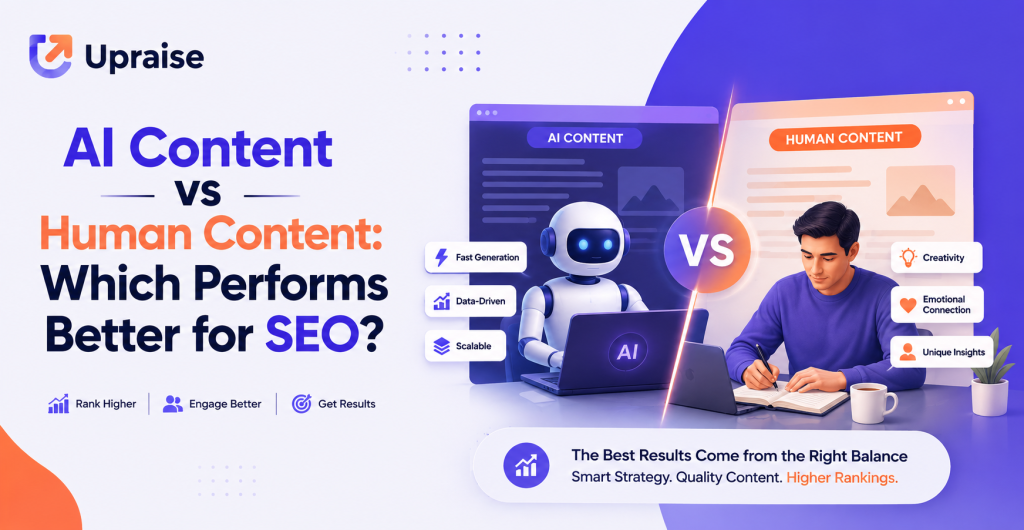
Should businesses use AI or human writers for SEO? Neither AI-generated content nor human-written content is automatically better for SEO. Google rewards content that is helpful, accurate, trustworthy, and satisfies user intent, regardless of how it was created. The real gap comes from quality, originality, and editorial oversight, not from who wrote the draft.
The honest answer to the ai content vs human content debate: both can rank, both can fail, and the strongest results come from combining them. This guide covers how each performs, how Google evaluates it, and how to build an ai content strategy that protects E-E-A-T.
What Is AI-Generated Content?
AI-generated content is text or video produced by ai writing tools powered by large language models (LLMs) such as GPT-4, Claude, and Gemini. These models are trained on massive public text and predict the next word, letting them draft articles, product descriptions, FAQs, and outlines in seconds. AI handles ai copywriting, summarization, and ideation, while humans provide direction and review.
Common ai generated content use cases include blog drafts, product descriptions, FAQs, category pages, and meta descriptions. The same stack powers keyword clustering, internal linking, and content briefs, accelerating ai writing for seo.
What Is Human-Written Content?
Human-written content is copy shaped by a person who brings original experience, expertise, and intent. Strong human written content reflects first-hand observations, proprietary data, and expert analysis that align with a brand’s voice. It is what makes a page feel distinct in a landscape filled with templated answers.
Human writers add value where AI still struggles: original reporting, lived experience, and brand personality. The strongest human vs ai writing workflows treat AI as an accelerator and human writers as the source of originality and trust.
How Does Google Evaluate AI Content?
Google evaluates content quality, not how it was produced. The google ai content guidelines, published through Google Search Central, focus on helpfulness, originality, accuracy, and transparency. Pages are rated against the Helpful Content System, the Search Quality Rater Guidelines, and E-E-A-T. The same rules apply to ai generated content for seo and human-written copy.
See Google’s guidance on AI-generated content, the helpful content documentation, and the Search Quality Rater Guidelines. AI content is not penalized for being AI, but low-quality content is, no matter who produced it.
Does Google Penalize AI-Generated Content?
No. Google does not penalize AI content simply for being AI-generated. Spam and low-quality content can be penalized regardless of authorship. What triggers ranking loss is thin content, templated output, and pages built mainly to manipulate rankings. A well-edited AI draft is treated the same as human written content of comparable quality.
What Does Google Mean by Helpful Content?
Helpful content solves a real problem for a real person. According to Google’s documentation, helpful pages show first-hand experience, demonstrate clear expertise, satisfy the search intent, provide original value beyond competing pages, and build trust through accurate sourcing. Helpful content ties directly into E-E-A-T, so the strongest results come when AI drafts are reviewed by people with real experience in the topic.
How Does AI Content vs Human Content Compare for SEO?
The ai vs human writers for seo comparison comes down to where each approach excels. The table below summarizes the trade-offs teams run into every day.
| Dimension | AI Content | Human Content |
| Speed | Drafts in seconds; 10x faster cycles | Slower; needs research, drafting, and editing |
| Expertise | Limited to patterns in training data | Original expertise, proprietary data, lived experience |
| Scalability | Easily produces hundreds of pages | Capacity-bound by writer time and cost |
| Originality | Risk of templated, generic phrasing | Distinct voice, unique angles, brand personality |
| Consistency | High structural consistency across pages | Varies by writer; needs strong briefs and QA |
| Cost | Low marginal cost per page | Higher cost per page, stronger brand equity |
| Brand voice | Needs tuning to feel on-brand | Authentic voice by default |
| Research | Summarizes and clusters data quickly | Better synthesis, criticism, contrarian views |
| Experience | Cannot produce first-hand experience | Real-world examples, screenshots, case studies |
The takeaway for human vs ai writing is not “AI or human” but “AI and human, in the right places.” The best strategies use AI for speed and human editors for trust signals, E-E-A-T, and differentiation. Upraise pairs both inside its SEO services.
What Are the Advantages of AI Content Marketing?
AI delivers real value inside a defined ai content marketing workflow:
- Faster production: Turn a 6-hour article into a 90-minute loop.
- Brainstorming at scale: Generate 20 headline variations or 50 meta descriptions in minutes.
- Content scaling: Produce thousands of product or location pages without linear headcount growth.
- Draft generation: Skip the blank page and refine instead of write from zero.
- SEO optimization: Cluster keywords, draft outlines, and suggest internal links automatically.
- Topic clustering: Map a pillar page to its supporting cluster in a single prompt.
- Content updates: Refresh old posts with new data and statistics on demand.
Used well, AI saves time without sacrificing quality. The mistake is treating the first draft as the final draft, which is where ai content optimization and editorial review matter.
What Are the Limitations of AI-Generated Content?
AI is powerful but not a complete substitute for a skilled team. Common ai content limitations:
- Lack of first-hand experience: AI cannot run a test or interview a customer.
- Limited originality: AI converges on average answers that blend existing pages.
- Possible factual inaccuracies: Models can hallucinate statistics and product specs.
- Generic phrasing: Default tone is bland, which hurts brand differentiation.
- Outdated knowledge: Training cutoffs leave AI blind to recent news and releases.
- Weak emotional storytelling: AI struggles with feelings tied to real human moments.
Human review remains essential. Editors verify facts, add experience, sharpen voice, and inject the perspective AI cannot manufacture. The result is human edited ai content that ranks because it is actually helpful.
When Should Businesses Use AI Instead of Human Writers?
The right answer depends on the content goal. AI fits repeatable, structured, lower-stakes content. Human writers remain essential where credibility and brand trust directly affect revenue or safety.
Which Types of Content Are Well-Suited for AI?
AI works well for content that follows clear patterns and has low reputational risk:
- Product descriptions and PDP copy at scale
- Meta descriptions, title tags, and image alt text
- FAQ answers grounded in existing documentation
- Content briefs and detailed outlines
- Large-scale category and location pages
- First drafts that editors will revise
When Is Human Expertise Essential for AI Content Strategy?
Human writers are essential for content where E-E-A-T signals directly affect rankings, conversions, or compliance:
- Thought leadership and original opinion pieces
- Medical, legal, and financial advice (YMYL topics)
- Case studies and proprietary research
- Brand storytelling and category-defining narratives
- Personal experience posts and expert analysis
- Decision-stage comparison and buying guides
This is also where Google’s E-E-A-T framework does the most work. Pairing AI for production with human experts for credibility is the core of modern ai content best practices.
Can AI Content Rank on Google?
Yes. AI content can rank on Google when it is helpful, accurate, well-optimized, and satisfies user intent. Ranking is driven by the same signals regardless of how the page is produced:
- Content quality: Depth, originality, and accuracy of the answer
- User engagement: Click-through rate, dwell time, and bounce behavior
- Technical SEO: Crawlability, schema, page speed, and mobile experience
- Topical authority: Internal links, entity coverage, and cluster depth
- E-E-A-T: Visible expertise, sourcing, and author credibility
- AI content editing: A human review layer that adds trust and originality
The pages that win combine ai seo content production with rigorous ai content optimization: fact-checking, internal linking, schema, and a clear point of view. Pairing content production with strong technical SEO moves a page from indexed to visible.
How Is AI Changing SEO and Content Marketing?
AI is reshaping how search works. Google AI Overviews, ChatGPT, Gemini, and Perplexity now answer many queries directly, accelerating the shift to zero-click search. Brands must optimize for AI-generated answers through Answer Engine Optimization (AEO) and Generative Engine Optimization (GEO), a core part of modern ai content best practices and seo content writing.
Key adaptations for content teams in 2026:
- Entity optimization: Make your brand, products, and people easy for AI to identify and cite.
- Structured content: Use clear headings, lists, and schema that AI can parse.
- Answer-first writing: Lead with a direct answer, then expand with proof.
- Conversational search: Optimize for natural-language questions, not just keywords.
- Citation-worthy claims: Add original data and sources AI wants to quote.
What Are the Biggest Mistakes Businesses Make When Using AI Content?
Most AI content failures are process failures. Common ai content mistakes:
- Publishing raw AI drafts without human review
- Skipping factual verification and source checks
- Keyword stuffing to chase volume rather than intent
- Producing generic content with no original angle
- Losing brand voice by accepting default AI tone
- Building weak internal linking across AI-generated pages
- Skipping expert review on YMYL and high-stakes topics
- Using lazy prompts that produce templated output
AI content without editorial rigor underperforms human-only content, while AI content with strong review consistently outperforms it on production speed.
Should Businesses Choose AI, Human Writers, or a Hybrid Approach?
For most teams, the hybrid approach is the best fit.
AI-only. Maximum speed, lowest cost, easy scaling. Weaker E-E-A-T, generic voice, higher factual risk. Best for low-stakes, high-volume pages.
Human-only. Highest originality, strongest brand voice, best E-E-A-T, full control over accuracy. Slow, expensive, hard to scale.
Hybrid approach (recommended). Combine AI for production and human writers for credibility. The workflow:
- Use AI to research, outline, and draft.
- Use human experts to verify facts and add experience.
- Use editors to sharpen voice and tighten structure.
- Use SEO specialists to optimize internal links, schema, and entities.
- Use QA reviewers to confirm E-E-A-T, originality, and helpfulness.
The hybrid model produces human edited ai content that meets Google’s quality bar and scales profitably. It is the foundation of any serious ai content strategy in 2026, and the default for seo content writing in high-performing teams.
Frequently Asked Questions
Can AI-generated content rank on Google?
Yes. AI-generated content can rank on Google when it is helpful, accurate, original, and meets user intent. Google evaluates content quality, not how it was produced. The strongest results come from AI drafts reviewed by human editors.
Does Google penalize AI-written content?
No. Google’s official guidance states that AI content is not penalized simply for being AI-generated. What Google penalizes is low-quality, spammy, or unhelpful content. Strong ai content best practices focus on quality, originality, and E-E-A-T. In ai copywriting workflows, the same rule applies to every draft.
Can AI replace content writers?
AI can replace parts of the writing workflow, such as research, outlining, and first drafts, but it cannot fully replace professional content writers. Human writers still lead on original insights, lived experience, and brand voice. The most effective teams use AI to do more, faster, while writers focus on the high-leverage work only humans can do.
Is human editing necessary for AI-generated content?
Yes. Human editing is necessary for AI-generated content to perform well in search. Editors verify facts, add experience, sharpen voice, fix structure, and inject originality. This is why human edited ai content consistently outperforms raw AI output on rankings and conversions.


