
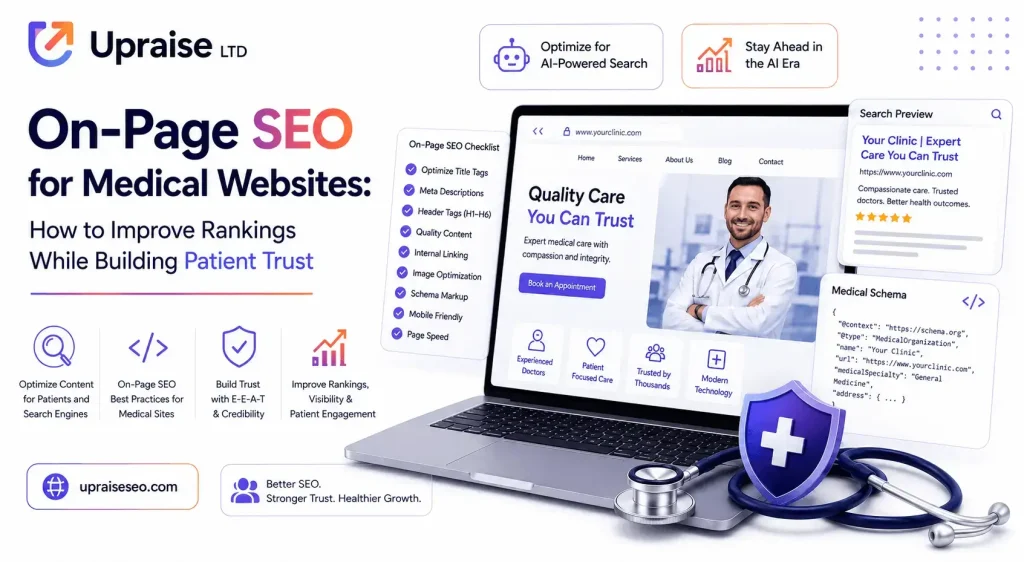
On-page SEO for Medical Websites is the practical work that determines whether a patient finds a trusted clinic or a less-qualified competitor. Many healthcare websites lose patients before they ever see a doctor. A practice may have excellent clinicians and still rank below outdated competitors because its website sends weak signals. Competition is increasing across Google Search as private clinics, dental groups, hospitals, and specialty centers target the same patients.
The strongest medical website SEO brings visibility and trust together. Clear content helps Google understand a page, while verified expertise helps patients feel comfortable booking. This guide explains the on-page SEO fundamentals that clinics and healthcare brands need, the YMYL and EEAT standards that make medical content different, and the practical steps that can improve rankings without making unsupported medical claims.
What Is On-Page SEO for Medical Websites?
On-page SEO is the process of improving individual website pages so search engines can understand their subject, relevance, and quality. It includes the visible content and the HTML signals around it: keywords, title tags, headings, internal links, images, schema markup, and URLs. For medical sites, effective on-page SEO must also make information clear, accurate, and trustworthy for patients.
Definition of On-Page SEO
On-page SEO, also called on-page optimization, tunes a page for a specific search intent. It connects the language patients use with useful answers, logical structure, and a straightforward next step. Good optimization makes a page easier to understand for both the reader and the crawler.
Difference Between On-Page, Technical SEO, and Off-Page SEO
On-page SEO deals with content and elements inside a page. Technical SEO deals with crawlability, indexing, mobile rendering, security, page speed, and site architecture. Off-page SEO deals with external authority, including backlinks, reviews, citations, and brand mentions. A healthcare SEO strategy needs all three, but on-page improvements are often the easiest place to begin because the practice controls the content.
Why Medical Websites Need Stronger SEO Than Other Industries
Healthcare is a YMYL, or Your Money or Your Life, topic. Poor information can influence a person’s health decision, so Google expects stronger evidence of expertise and trust. Patients also examine credentials, reviews, treatment information, and contact details before they book. A medical page therefore has to satisfy search intent while reducing uncertainty for a real person.
Why On-Page SEO Matters for Healthcare Providers
Well-optimized pages attract more relevant visitors and give those visitors a clearer path to care. They can also improve the value of paid campaigns and referral traffic because patients land on pages that answer their immediate questions.
- Higher Google rankings: Clear topical focus and helpful page structure make relevance easier to assess.
- More qualified traffic: Service and location terms attract people looking for a specific provider or appointment.
- Better patient experience: Readable copy, clear navigation, and accessible design reduce friction.
- More appointment bookings: A relevant page with a visible phone number, booking form, or WhatsApp option supports action.
- Improved credibility: Doctor credentials, editorial review, and trusted sources help patients judge the practice.
- Stronger EEAT signals: The page can demonstrate Experience, Expertise, Authoritativeness, and Trustworthiness at the point of search.
- Better local visibility: Accurate service-and-location pages support local searches for clinics, hospitals, and practices.
Essential On-Page SEO Elements Every Medical Website Needs
Healthcare website optimization works best when every page has one clear purpose and supports it with consistent signals. These elements should be part of every medical website optimization project.
Keyword Research for Medical Services: A Medical Website SEO Foundation
Start with search intent, not a keyword list. Service keywords describe what the practice offers, location keywords identify where it operates, symptom keywords reflect early-stage research, and long-tail keywords reveal specific questions. Map each group to the right page. A treatment page should not compete with a blog post for the same query, and a generic homepage should not carry every service term.
SEO-Friendly Title Tags for Healthcare SEO
Keep title tags concise, place the main term near the beginning, and make the benefit clear. A useful working range is about 50 to 60 characters, although Google measures display width rather than a fixed character limit. Example: On-Page SEO for Medical Websites | Upraise. Avoid titles such as Home | Clinic Name, which tell neither the searcher nor Google what the page offers.
Compelling Meta Descriptions for Medical SEO
A meta description should explain the page’s value and encourage a qualified click. Aim for roughly 140 to 160 characters, include the primary keyword naturally, and add a realistic call to action. Example: Learn on-page SEO for medical websites, improve Google visibility, and build patient trust with a practical healthcare checklist.
Optimized Heading Structure (H1 to H3)
Use one H1 for the page topic, H2 headings for major sections, and H3 headings for supporting points. Do not skip from H1 to H3 simply for visual styling. A logical hierarchy helps readers scan a long article and helps search engines identify the relationship between a topic and its subtopics.
High-Quality Medical Content
Healthcare content should be accurate, original, readable, and written for patients rather than search engines. Explain clinical terms in plain language, state limitations, and avoid diagnosing or prescribing through a marketing page. Reference organizations such as the World Health Organization, the Centers for Disease Control and Prevention, the National Institutes of Health, and the Mayo Clinic when their guidance supports a claim.
Internal Linking Strategy
Link service pages to relevant doctor profiles, related FAQs, appointment pages, and educational articles. A blog post about skin conditions can link to a dermatologist profile and a dermatology service page. Use descriptive anchors rather than “click here.” For wider growth, connect this work with technical SEO services, content marketing services, and an SEO audit.
Image Optimization
Compress images, use WebP where supported, and choose descriptive file names such as dermatologist-consultation.webp. Alt text should describe the image’s purpose, not repeat a keyword unnaturally. Obtain documented consent before publishing identifiable patient images, and never rely on a stock photograph to imply a clinical outcome.
Medical Schema Markup
Schema markup gives search engines additional context about a page. Relevant types may include Medical Organization, Physician, Local Business, FAQ, Review, and Breadcrumb List. Follow Google Search Central’s structured data guidance, validate the implementation, and never use schema to mark up information that is not visible on the page.
URL Optimization
Keep URLs short, readable, and stable. A good example is example.com/services/dental-implants/. A poor example is example.com/?page_id=12847&service=3. Use lowercase words and hyphens, avoid unnecessary dates on evergreen pages, and do not create multiple URLs for nearly identical services.
How EEAT and YMYL Affect Medical SEO
EEAT describes Experience, Expertise, Authoritativeness, and Trustworthiness. Because healthcare is YMYL content, these signals carry special weight. Good healthcare SEO does not invent credentials or overstate results; it makes real expertise visible and gives patients a transparent reason to trust the information.
Experience
Show first-hand experience through clinician-written content, clearly explained procedures, anonymized case examples where appropriate, and practical details about what a patient can expect. Do not imply that a general copywriter has performed a treatment.
Expertise
Publish author bios with relevant qualifications, specialties, board certifications, and years of practice. Identify the medical professional who reviewed high-stakes content. The reviewer should be qualified for the topic, not simply a company employee.
Authoritativeness
Build authority through accurate citations, reputable medical partnerships, professional profiles, and references from recognized organizations. Link to original guidance where possible, rather than citing an unattributed summary.
Trustworthiness
Make contact information, privacy policies, editorial standards, review dates, and correction processes easy to find. Update medical information when guidance changes. A visible “medically reviewed by” line and a current review date are small details that can materially improve transparency.
On-Page SEO Best Practices for Clinics, Hospitals, and Healthcare Brands
Practical healthcare website optimization focuses on the pages patients use before booking.
- Service pages: Explain the service, who it may suit, preparation, process, risks or limitations, and the booking route without making guarantees.
- Doctor profile pages: Include specialties, qualifications, languages, locations, professional memberships, and links to relevant services.
- Location pages: Add unique address, hours, access, parking, team, and service details for each genuine branch.
- FAQ sections: Answer real patient questions in short, direct paragraphs before adding detail.
- Mobile optimization: Make phone numbers and booking controls easy to tap, with readable text and no horizontal scrolling.
- Page speed: Compress media, reduce unnecessary scripts, and test templates on a realistic mobile connection.
- Patient-friendly language: Replace unexplained jargon with plain descriptions and define necessary clinical terms.
- Calls to action: Offer a specific next step, such as booking an appointment, calling reception, or requesting a consultation.
- Local SEO: Keep the practice name, address, phone, hours, and service information consistent across the site and business listings.
Common On-Page SEO Mistakes Medical Websites Should Avoid
- Thin content: Short pages that provide no useful detail are unlikely to satisfy competitive intent.
- Duplicate pages: Copying one service page across several locations creates little unique value.
- Keyword stuffing: Repetition makes medical content harder to read and can signal manipulation.
- Poor metadata: Missing or generic titles waste opportunities to earn qualified clicks.
- Missing H1 and alt text: These weaken structure and accessibility.
- Weak internal linking: Important pages become difficult for users and crawlers to discover.
- Outdated medical information: Old guidance damages trust and can create safety concerns.
- Broken links: Dead references frustrate users and weaken the page experience.
- Slow pages and poor mobile usability: Friction encourages patients to return to the search results.
On-Page SEO Checklist for Medical Websites
| Area | Check | Complete |
| Metadata | Optimized title tag and meta description | |
| Structure | One optimized H1 and logical H2-H3 hierarchy | |
| Keywords | Primary keyword and secondary terms added naturally | |
| Links | Internal links and authoritative external references included | |
| Trust | Author bio, expert review, and updated medical information shown | |
| Schema | Relevant Medical Organization, Physician, FAQ, or Breadcrumb schema validated | |
| Media | Images compressed, named clearly, and given useful alt text | |
| Experience | Mobile-friendly and fast-loading layout tested | |
| Conversion | Clear appointment or consultation CTA provided | |
| FAQ | At least four direct patient questions answered |
Should You Hire a Healthcare SEO Agency?
In-house teams can manage some SEO tasks, but medical SEO combines research, content, technical implementation, local optimization, and YMYL review. A specialist can save time, build a clearer healthcare SEO strategy, reduce compliance risks, and maintain consistent quality while the practice focuses on patient care. No ethical agency can guarantee a number-one ranking, but disciplined optimization can improve visibility and patient acquisition over time.
Upraise helps healthcare businesses combine on-page optimization with technical SEO, content marketing, AI SEO, and industry-specific SEO solutions. The work is measured through visibility, qualified enquiries, and organic growth rather than ranking promises. A healthcare SEO consultation can identify which service pages, technical issues, and trust signals should be addressed first.
Frequently Asked Questions About Medical Website SEO
How long does medical SEO take to show results?
Timing depends on competition, site authority, technical health, and implementation quality. Sustainable growth usually requires consistent work over several months.
What makes healthcare SEO different?
Healthcare is a YMYL niche, so accuracy, expert credentials, authoritative references, and transparent review processes matter especially strongly.
Should clinics create separate location pages?
Create one when each location has unique services, staff, hours, access information, and patient details. Do not duplicate the same copy across cities.
Can a small practice compete with a hospital?
Yes. Focused local service pages, strong doctor profiles, relevant reviews, and useful answers can help a practice compete for specific searches.
Conclusion
On-page SEO for medical websites is a trust system as much as a ranking system. Accurate content, useful structure, visible credentials, authoritative references, strong internal links, and a simple booking path help both Google and patients understand the value of a practice.
Start by auditing your medical website against the checklist. Fix the pages that matter most to patients, add expert review and current references, and measure progress consistently. If your team needs a partner, contact Upraise for a healthcare SEO consultation focused on patient trust, EEAT, and sustainable organic growth.


