
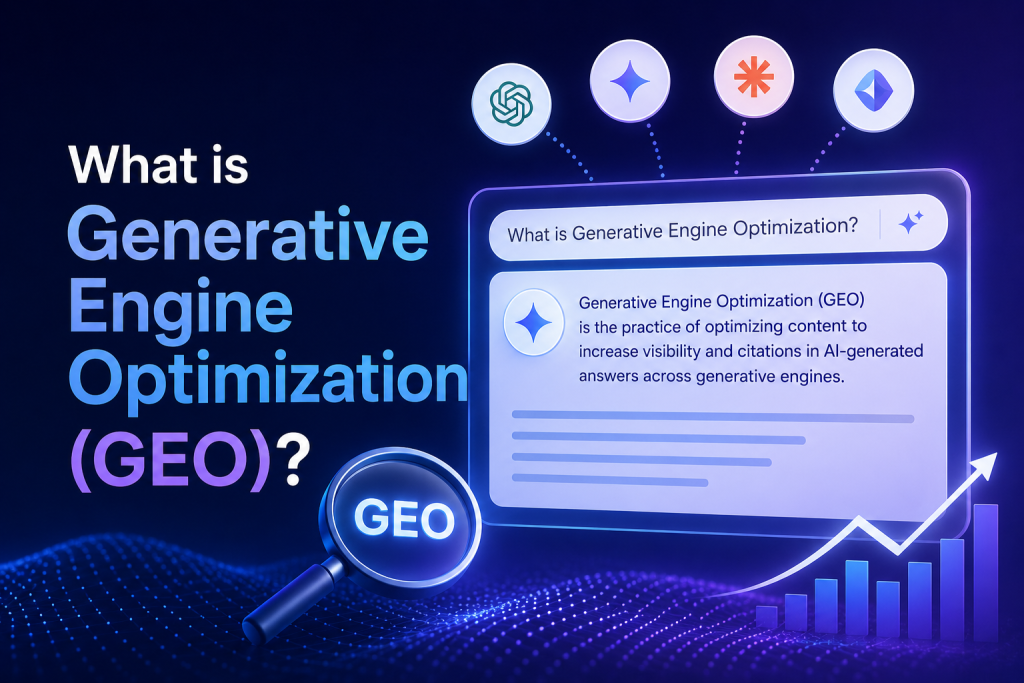
How do brands appear in ChatGPT and Google AI Overviews? When users ask AI tools for recommendations, some companies get mentioned while others stay invisible. The answer lies in generative engine optimization geo.
Generative engine optimization geo (GEO) is the process of optimizing content so AI-powered search engines like Google AI Overviews, ChatGPT, Gemini, and Perplexity can understand, summarize, and reference your content in generated answers. Unlike traditional search, where users click through blue links, generative AI delivers direct answers. GEO ensures your brand is part of those answers.
This article covers what GEO means, how it works, how it differs from traditional SEO, and practical strategies to implement it in 2026. Whether you run a SaaS company, a service agency, or an e-commerce store, understanding GEO gives you a competitive edge in AI search.
What is Generative Engine Optimization?
Generative engine optimization is the practice of structuring and optimizing digital content so AI engines can extract, trust, and cite it when generating answers. The generative engine optimization definition extends beyond keywords and rankings. It focuses on making your content AI-ready.
AI-powered search engines include Google AI Overviews, ChatGPT, Gemini, and Perplexity. These tools do not simply return links. They read multiple sources, understand context, and synthesize answers. This is what generative search engine optimization means in practice. According to Search Engine Land, fewer than 15% of sources cited in AI Overviews rank in the top 10 organic results, showing that GEO requires specialized tactics beyond traditional SEO.
GEO focuses on five key elements:
- Entity authority: AI engines recognize brands as entities. Strong authority means your brand is known and referenced across the web.
- Contextual relevance: Content must clearly relate to the topics users ask about.
- Citations: AI engines prefer factual, well-sourced, and linkable content.
- Structured answers: Clear headings, lists, and summaries help AI extract information.
- Answer readiness: Content should directly answer questions without forcing readers to dig.
For example, when a user asks ChatGPT for the “best CRM software,” the AI references brands with strong entity authority and structured content that clearly answers comparison questions. This is geo ai search optimization in action.
Why Generative Engine Optimization GEO Matters Now
Traditional SEO alone is no longer enough. AI Overviews now appear at the top of search results, giving users instant answers without clicking websites. This shift creates zero-click searches, where users get what they need directly from AI-generated summaries.
Search habits are changing. Users increasingly ask conversational questions and expect immediate, accurate answers. According to McKinsey, over 40% of search queries in 2026 trigger some form of AI-generated response. Brands must optimize for AI visibility, not only rankings. Early GEO adopters gain competitive advantages as AI search continues to grow.
The future of seo ai depends on adapting to these changes. Geo optimization is not a replacement for SEO but an essential layer that ensures your content appears where users actually consume information todayز
How is GEO Different from SEO?
Understanding the difference between GEO and SEO helps businesses allocate resources correctly. Here is a clear comparison:
- Traditional SEO focuses on ranking webpages, optimizes for clicks and SERP positions, and relies heavily on keywords and backlinks.
- GEO focuses on being cited or summarized by AI, optimizes for answer generation, and prioritizes context, entities, structure, and factual clarity.
The geo vs seo distinction matters because the goals differ. SEO chases position one in blue links. GEO chases inclusion in AI-generated answers. What is the difference between seo and geo? SEO drives clicks; GEO drives visibility in answers users read without clicking. The difference between seo and geo is fundamental: rankings versus AI citations, clicks versus answer visibility, keyword matching versus intent satisfaction.
Importantly, generative engine optimization vs traditional seo is not a battle. GEO builds on strong SEO foundations. You cannot optimize for AI engines with poor technical SEO, thin content, or weak site structure.
How GEO and SEO Work Together
GEO functions as an extension of SEO. It still depends on:
- Technical SEO
- High-quality content
- Internal linking
- Structured pages
- Topical authority
SEO supports GEO through semantic relevance, clear site structure, entity associations, and trust signals. A simple workflow looks like this:
SEO foundation leads to structured content, which enables AI understanding, which produces AI citations.
Without the SEO foundation, AI engines cannot find, crawl, or trust your content. Without GEO optimization, even well-ranked content may never appear in AI-generated answers.
How Generative Engine Optimization GEO Works
Understanding how does generative engine optimization work helps you implement it effectively. The geo optimization process involves several steps:
- Crawl and index content: AI engines access your pages through traditional crawling. Technical SEO ensures they can read your content.
- Understand entities and relationships: AI identifies brands, people, products, and concepts, then maps how they relate.
- Evaluate authority and trust: Content from established, cited sources receives preferential treatment.
- Synthesize answers from multiple sources: AI combines information from various trusted pages.
- Reference or summarize trusted content: The final answer includes or paraphrases content it deems reliable.
Key geo ranking factors include entity recognition, contextual understanding, citation signals, factual consistency, structured formatting, and E-E-A-T signals. Content that scores well across these dimensions has higher chances of AI citation. According to Search Engine Journal, websites with strong entity signals are 3x more likely to be cited in AI-generated answers.
How to Rank in Generative AI Engines
Here are practical tactics for how to do generative engine optimization:
- Use answer-focused headings that match common questions.
- Add FAQ sections with concise, direct answers.
- Structure content clearly with bullet points and short paragraphs.
- Build topical authority by covering subjects comprehensively.
- Improve factual accuracy and cite authoritative sources.
- Use schema markup to help AI understand content context.
- Strengthen E-E-A-T signals with author bios and credentials.
- Mention entities naturally within relevant contexts.
- Create concise summaries AI can quote directly.
These generative engine optimization strategies and generative engine optimization best practices focus on practical implementation, not technical complexity. Many businesses partner with a generative engine optimization agency to implement these tactics efficiently.
GEO Optimization Process for 2026
The geo optimization process follows a clear sequence. First, audit your existing content for AI readiness. Second, implement structured data and schema markup. Third, build topical authority through comprehensive coverage. Fourth, strengthen entity signals by building brand mentions across trusted sites. Fifth, monitor AI citations and refine based on results.
Companies investing in generative engine optimization services today will lead as AI search matures. The future of seo ai rewards early adopters who structure content for both traditional and generative search experiences.
Why GEO Matters for Your Business
GEO helps businesses increase AI visibility, build brand authority, reach users during AI-assisted searches, gain competitive advantages, and improve trust and recognition. Different business types benefit in specific ways:
- B2B businesses: GEO ensures your solutions appear when decision-makers research tools and services through AI assistants.
- SaaS companies: GEO helps your product get mentioned in comparison queries and recommendation requests.
- Service providers: GEO increases visibility for local and specialized service searches.
- E-commerce brands: GEO improves product discovery through AI-generated buying guides and reviews.
Working with a generative engine optimization agency or exploring generative engine optimization services from established generative engine optimization companies can accelerate implementation. Contact Upraise for GEO consulting.
Check if Your Site Appears in AI Overviews
Testing AI visibility requires manual effort. There is currently limited official reporting for AI visibility. Here are practical ways to check:
- Search branded questions in Google and look for AI Overview citations.
- Test prompts in ChatGPT, Gemini, and Perplexity about your industry.
- Monitor AI-generated answers for mentions of your brand or content.
- Check if competitors appear where you do not.
Manual testing remains important in 2026. Use generative engine optimization tools and best ai tools for generative engine optimization to track mentions and analyze AI visibility patterns over time.
Benefits of GEO
- Increased AI search visibility
- Better brand authority
- More trust signals
- Long-term search sustainability
- Competitive differentiation
- Improved content discoverability
- Better alignment with future AI search trends
Frequently Asked Questions
What is GEO used for?
GEO is used to optimize content so AI-powered search engines can understand, summarize, and reference it in generated answers. It helps brands appear in AI Overviews, ChatGPT responses, and other generative search experiences.
What is an example of GEO?
A practical example is a SaaS company that structures its product pages with clear comparisons, FAQ sections, and authoritative citations. When users ask AI tools for best project management software, the company’s content gets referenced because it is AI-ready.
Is GEO replacing SEO?
No. GEO complements SEO rather than replacing it. GEO builds on strong SEO foundations including technical optimization, quality content, and topical authority. You need both to succeed in modern search.
How does generative engine optimization work?
GEO works by structuring content so AI engines can crawl, understand entities, evaluate authority, synthesize answers from multiple sources, and reference trusted content. Key factors include entity recognition, contextual understanding, citation signals, and E-E-A-T signals.
What are generative engine optimization best practices?
Best practices include using answer-focused headings, adding FAQ sections, structuring content clearly with bullets, building topical authority, improving factual accuracy, using schema markup, strengthening E-E-A-T signals, mentioning entities naturally, and creating concise summaries AI can quote.


