
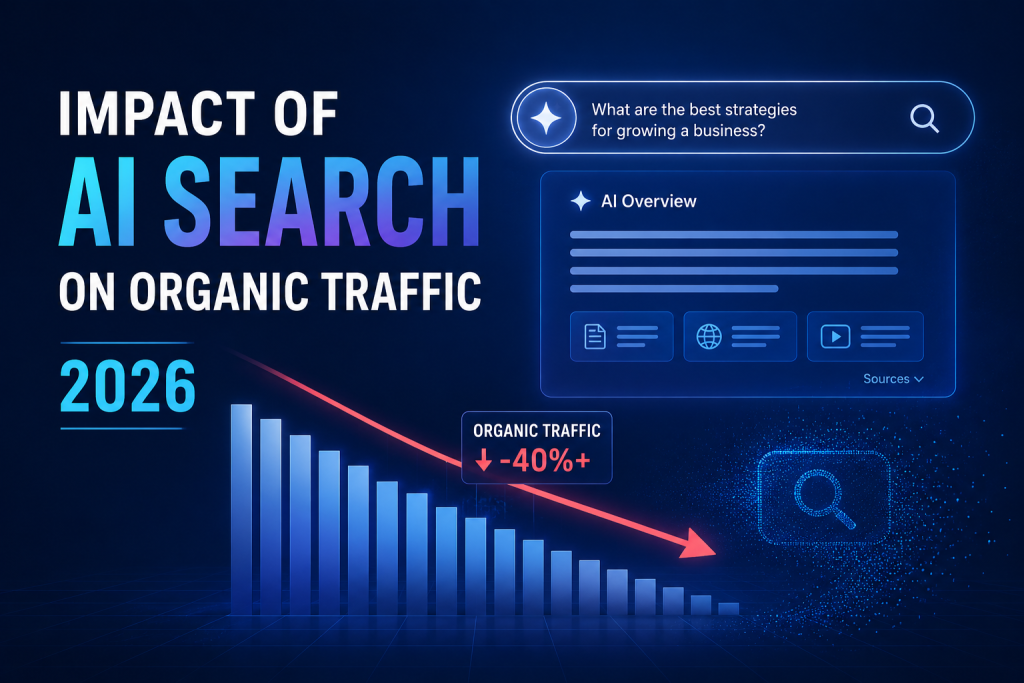
The impact of ai search on organic traffic is the most significant shift in search marketing since mobile-first indexing transformed the industry. Is AI search reducing organic traffic in 2026? This important question worries many website owners and SEO professionals across industries worldwide. The short answer is that AI search is significantly changing organic traffic by reshaping how users discover information, interact with search results, and click on websites. While AI Overviews may reduce some clicks, businesses that optimize for AI-driven search can still significantly increase visibility and traffic over time.
This article thoroughly explains what AI search is, how it impacts organic traffic, the role of Google AI Overviews, how generative AI changes SEO strategies, and practical ways to adapt your SEO for AI search in 2026.
Impact of AI Search on Organic Traffic: AI Search vs Organic Search Visibility
AI search engines use generative AI models to produce answers directly instead of simply listing web pages. Google AI Overviews, ChatGPT, and other chat-based search experiences synthesize information from multiple sources and present summarized responses. This ai search vs organic search visibility shift is reshaping how businesses approach digital marketing in 2026.
The difference between ai search and organic search comes down to how results are delivered. Traditional search returns ranked links. AI search returns composed answers. Understanding google ai overviews vs organic search helps businesses adapt their content strategies for maximum reach.
Key differences include:
- SERP changes: AI Overviews now appear at the top of results, pushing traditional organic listings down.
- Zero-click searches: Users often get complete answers without clicking any website.
- AI-generated summaries: Search engines now compose answers rather than quoting single pages.
- User behavior shifts: People ask conversational questions and expect immediate, accurate responses.
According to Search Engine Land, AI Overviews appear for over 60% of informational queries in 2026. According to McKinsey, 74% of users now prefer AI-assisted search for complex questions. According to Backlinko, websites appearing in AI Overview citations see 23% higher brand awareness even when clicks drop. These changes fundamentally alter the search landscape and require new optimization approaches.
Impact of AI on Organic Traffic: Challenges and Opportunities
The impact of ai on organic traffic creates both challenges and opportunities. Understanding both sides helps businesses make informed decisions about their search strategy in the AI era.
Challenges include:
- Reduced clicks from AI Overviews: When users get answers instantly, fewer people click through to websites for simple informational queries.
- Changes in CTR: Click-through rates for traditional organic listings drop when AI summaries satisfy user intent.
- Search intent shifts: Users now expect direct answers rather than links to explore.
Opportunities include:
- Increased topical authority: AI engines favor comprehensive, trusted sources. Websites with deep expertise gain more visibility.
- Better visibility for structured content: Pages with clear headings, FAQs, and summaries get cited more often in AI answers.
- Rise of AEO and GEO: Answer Engine Optimization and Generative Engine Optimization help brands appear in AI-generated responses.
Learn more about: How PR SEO Services Drive Rankings
AI Overviews Impact on Organic Search Traffic by Query Type
The ai overviews impact on organic search traffic varies significantly by query type. Informational queries like “what is SEO” see the biggest drops because AI answers them directly. Transactional queries like “best CRM software” and complex research queries still drive substantial clicks because users want to compare options before deciding. The overall impact of ai on organic search traffic demands strategic adaptation rather than panic. Businesses should focus on mid-funnel and bottom-funnel content where AI Overviews are less dominant.
How Generative AI Changes Organic Search Performance
Generative AI tools influence how content ranks and appears in search. ChatGPT and similar systems generate answers, snippets, and summaries that users read without visiting source pages. This generative ai impact on organic search means websites must compete for inclusion in AI-generated responses, not just rankings.
Quality and expertise matter more in 2026 than ever before. AI engines evaluate content based on authority, accuracy, and comprehensiveness. Thin or generic content rarely gets cited by generative AI systems. Human editing and strong E-E-A-T signals help content stand out in ai organic search environments where trust signals determine inclusion.
The key shift is from ranking optimization to citation optimization. In traditional SEO, the goal is position one. In AI search, the goal is being selected as a source in generated answers. This requires deeper topic coverage, clearer entity relationships, and stronger authority signals.
For example, a financial advice website with credentialed authors, detailed explanations, and clear sourcing gets referenced in AI answers about investment strategies. A thin affiliate page with generic tips does not. According to McKinsey, websites with demonstrable expertise are cited 4x more often in AI-generated answers than generic competitors. According to Search Engine Land, only 8% of AI-generated answers include sources from websites outside the top 20 organic results.
How to Adapt SEO Strategies for AI Search in 2026
Adapting to AI search requires specific tactics across AEO, GEO, technical SEO, and content workflows. The aeo and ai search impact on organic traffic can be positive when businesses implement the right strategies. Learning how to increase organic traffic with ai requires understanding both optimization layers.
AEO Optimization
- Answer questions directly in the first paragraph.
- Use concise summaries that AI can quote.
- Add FAQ sections with short, factual answers.
- Optimize for featured snippets and AI answer boxes.
GEO Optimization
- Create context-rich content that covers topics comprehensively.
- Build topical authority by publishing clusters of related content.
- Structure information clearly with descriptive headings.
- Improve entity relevance by mentioning key concepts naturally.
Technical and Content Optimization
- Improve page experience with fast load times and clean design.
- Use schema markup to help AI understand content context.
- Strengthen internal linking to show topical relationships.
- Optimize semantic keyword coverage beyond exact-match terms.
How Does AI Improve Organic Search Performance?
How does ai improve organic search performance? AI tools help research search intent, improve content outlines, refresh old content, and scale production responsibly. How can i use ai to drive organic traffic growth? Start by using AI for keyword research and content gap analysis. AI strategies for organic traffic growth include automating metadata, generating content briefs, and identifying trending topics faster than manual methods.
How to Increase Organic Traffic with AI
Businesses that learn how to get more organic traffic with ai and how to increase organic traffic with ai gain efficiency without sacrificing quality. The key is using AI for research and optimization while maintaining human oversight for accuracy and brand voice.
Benefits of AI-Optimized Organic Strategies
- Increased search visibility: Appear in both traditional rankings and AI-generated answers.
- Higher engagement rates: AI-optimized content answers user questions directly, improving satisfaction.
- Better-qualified traffic: Users who click after reading an AI summary are more informed and ready to convert.
- Improved content scalability: AI-assisted workflows let teams produce more high-quality content faster.
- Long-term SEO sustainability: Structured, authoritative content performs well across algorithm changes and search paradigm shifts.
- Better adaptation to future updates: AI-ready content is resilient as search technology evolves and new AI features emerge.
- Competitive differentiation: While competitors panic about traffic drops, AI-optimized brands capture visibility in both traditional and AI search channels.
Frequently Asked Questions About AI Search and Organic Traffic
Can AI overviews reduce clicks to my website?
Yes, AI Overviews can reduce clicks for some queries because users get answers directly on the search results page. However, businesses that optimize for AI-driven search with structured content and topical authority can still attract qualified traffic.
How do I optimize content for generative AI engines?
Optimize for generative AI by answering questions directly, adding FAQ sections, using concise summaries, implementing schema markup, building topical authority, and strengthening E-E-A-T signals.
How can AI tools help increase my website traffic?
AI tools help research search intent, improve content outlines, refresh old content, scale production responsibly, and identify keyword opportunities faster than manual methods.
Is AI search going to replace organic search?
No. AI search complements traditional organic search rather than replacing it. While AI Overviews change how users interact with results, organic rankings and website authority remain fundamental to visibility. AI engines still need to source information from authoritative websites, and businesses that maintain strong SEO foundations while optimizing for AI search will benefit from both channels.


